
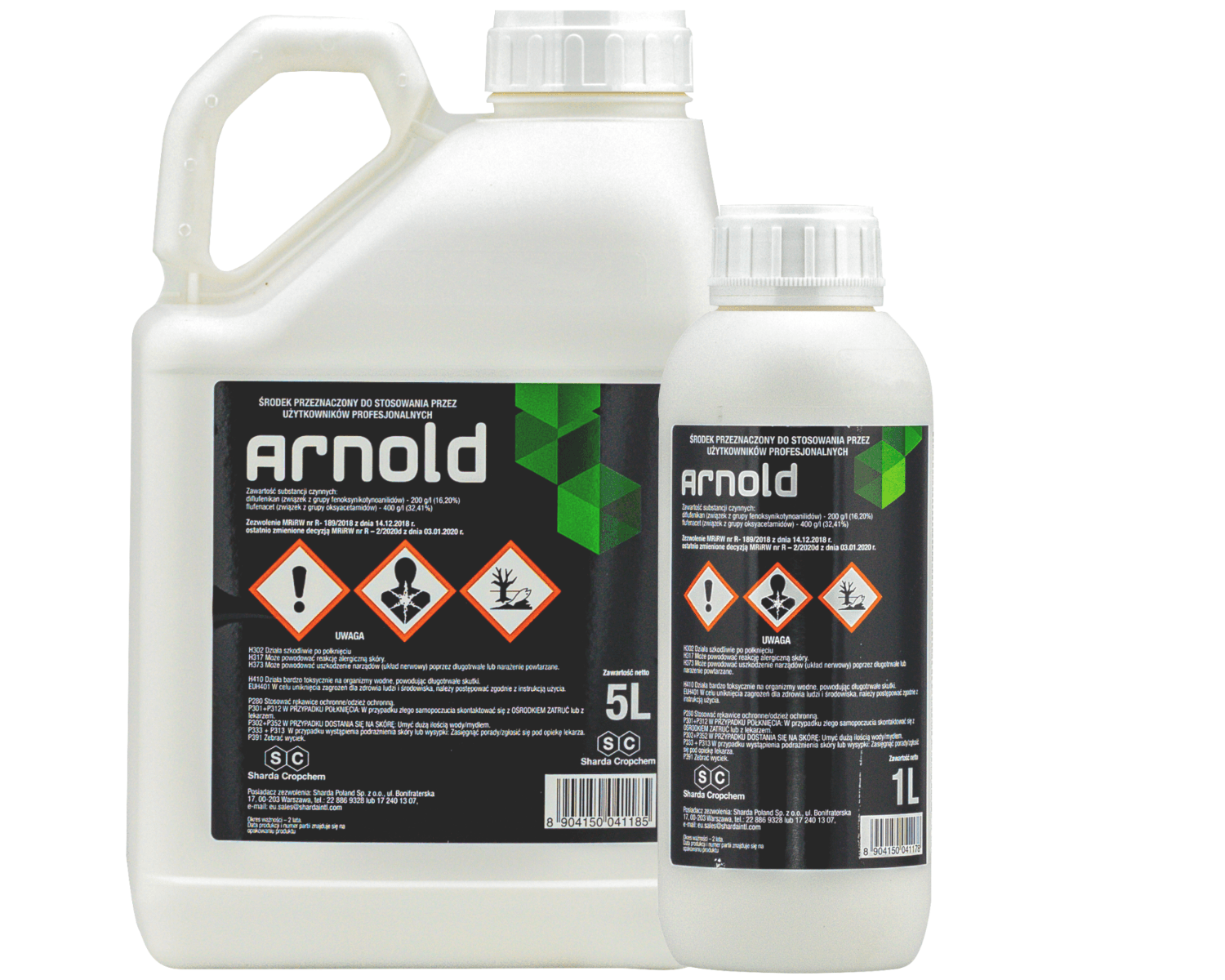
Arnold (Diflufenican, Flufenacet) – Herbicide

€69.95








Card 1-3 · Advance 3-5 business days
Final price plus shipping according to § 19 UStG without VAT ID
Product information
- Serie / Lizenz
- Bayer
- Versandgewicht
- 1,10 kg
- Artikelnummer
- HT-41360-V001
Arnold – a herbicide with the power of two active ingredients What are they like? Advantages of using a pesticide to control weeds Arnold? Effectively fights unwanted weeds, It contains two active ingredients: Diflufenican and Flufenacet, which complement each other., which makes Arnold even more effective, It has a quick action, allowing you to quickly eliminate the problem Product features Arnold – a herbicide with the power of two active ingredients What are they like? Advantages of using a pesticide to control weeds Arnold? Effectively fights unwanted weeds, It contains two active ingredients: Diflufenican and Flufenacet, which complement each other., which makes Arnold even more effective, It has a quick action, allowing you to quickly eliminate the problem Will not limit the choice of successor plants, It acts on both the soil and the leaves - a wide spectrum of effects Arnold is a plant protection product from the Sharda company from the herbicide group It is in the form of a concentrated suspension that is diluted with water (SC) It is a selective preparation It has a systemic effect It is intended for soil and foliar application for weed control A product designed for use with self-propelled or beetle sprayers What is the active ingredient content in Trinity 590 SC herbicide? Diflufenican – (related fruits from the phenoxynicotinanilide group) - 200 g/l (16.20%), flufenacet (related fruits from the oxyacetamide group) - 400 g/l (32.41%) How does Arnold herbicide work? As you already know, the agent fighting weed Arnold contains two active ingredients: chlorotoluron, diflufenican and pendimethalin Each of these substances has a different mechanism of action, which means that these substances complement each other This means it doesn't matter what type of weed would attack your plants - you don't have a chance with these two! Diflufenican is a contact-acting herbicide (it moves easily). occurs in the plant) and is classified as an inhibitor of carotenoid biosynthesis in weed cells The absence of these structures leads to whitening of the leaf tissue and cell breakdown, which is particularly visible in new tissue After application, diflufenican remains on the soil surface for a long time, producing a thin layer that has a contact effect on the emergence of young, actively growing ce weeds Provides protection for up to 8 weeks after application Flufenacet is a herbicide with systemic action, classified as an inhibitor of long-chain fatty acid synthesis It is absorbed mainly by the roots and the part under the cotyledons that sprouts weeds Diflufenican and flufenacet remain active in the soil for many weeks after treatment, maintaining high herbicidal effectiveness even in the later period Optimal soil moisture contributes to the high effectiveness of the product The best herbicidal effect is achieved by using cApply in the early stages of weed development, i.e. h. during germination or shortly after emergence, in the seedling phase What weeds does Arnold's pesticide work against? Before plant emergence: Sensitive weeds: chickweed, corn broom, bedstraw, blackgrass If the product is used after plant emergence: Sensitive weeds: Small geranium, wormwood, field violet, common chickweed, purple lilac, field poppy, unscented maruna, beach maruna, gorse, ivy speedwell, Persian speedwell, bedstraw, field chamomile, common chamomile, turnip radish, common locust, field bunch, Blackgrass. moderately sensitive weeds: cornflower, volunteer rapeseed, volunteer cereals How do you use Arnold herbicide? Detailed information on the dosage and use of Arnold can be found in the “Dosage” section and on the pesticide label. included in the downloadable files On which crops can Arnold herbicide be used? Winter wheat, winter triticale, winter rye, winter barley How long is the waiting period when using Alnold herbicide in winter cereals? The waiting period, i.e. the period from the last use of the product to the time of harvest, does not apply to Arnold Can Arnold be used for weed control without having to worry about successor plants? The product poses no danger to subsequent crops If a plantation treated with the product needs to be closed early due to damage to the plants by frost, pests or diseases, the field can be sown with grain protected by the product, provided that the product is not applied in the same season Plant protection products with substance open Diflufenican in spring The plantation was plowed and no beets, peas (on light soils), rapeseed, oats, bulbous vegetables and cabbage were grown The remaining grain can be grown after plowing to a depth of 20 cm What are they like? Recommendations for the use of service fluid made with Arnold Measure? Sow the grain on the same area from depth (3-4 cm) cover c Work the seeds thoroughly into the soil On humus soils and chernozems, the agent can have a reduced herbicidal effectiveness Management strategy promoting immunity To minimize the risk, growth and development of weed resistance to herbicides should be carried out in accordance with good practice agriculture: â Strictly follow the instructions on the crop protection product label. â Ensure that you use the product at the recommended dose and within the recommended time for optimal weed control, â Adapt the selection of herbicide and the decision to implement the treatment to the prevailing conditions of possible (potential) weed infestation, taking into account the dominant species genes and harmfulness thresholds Available pack sizes: Please select the desired pack size (e.g. 1 L, 3 L, 5 L, 10 kg) in the configurator use a rotation of herbicides (active ingredients) with different mechanisms of action use a mixture of herbicides (active ingredients) with different mechanisms of action Use in rotation and/or mixture, herbicides act on multiple life processes of weeds (with different mechanisms of action) Use a herbicide with a specific mechanism of action only once per pregnancy during the growing season of the crop adapt cultivation methods to the prevailing conditions in the field, in particular the type and intensity of weeds, â use various methods of weed control, including crop rotation, etc., â use certified seeds, â clean agricultural machinery to prevent the transfer of weed propagating material to other sites, â inform the permit holder if he is not satisfied with weed control, â For detailed information, please contact your advisor, holder authorization or representative of the permit holder Use the product not: for plants weakened or damaged by diseases, pests, frost or drought, â before expected frosts and in the case of due to a large daily temperature fluctuation, â in undersown cereals legumes
Produktmerkmale
- Arnold – a herbicide with the power of two active ingredients What are they like? Advantages of using a pesticide to control weeds Arnold? Effectively fights unwanted weeds, It contains two active ingredients: Diflufenican and Flufenacet, which complement each other., which makes Arnold even more effective, It has a quick action, allowing you to quickly eliminate the problem Product features Arnold – a herbicide with the power of two active ingredients What are they like? Advantages of using a pesticide to control weeds Arnold? Effectively fights unwanted weeds, It contains two active ingredients: Diflufenican and Flufenacet, which complement each other., which makes Arnold even more effective, It has a quick action, allowing you to quickly eliminate the problem Will not limit the choice of successor plants, It acts on both the soil and the leaves - a wide spectrum of effects Arnold is a plant protection product from the Sharda company from the herbicide group It is in the form of a concentrated suspension that is diluted with water (SC) It is a selective preparation It has a systemic effect It is intended for soil and foliar application for weed control A product designed for use with self-propelled or beetle sprayers What is the active ingredient content in Trinity 590 SC herbicide? Diflufenican – (related fruits from the phenoxynicotinanilide group) - 200 g/l (16.20%), flufenacet (related fruits from the oxyacetamide group) - 400 g/l (32.41%) How does Arnold herbicide work? As you already know, the agent fighting weed Arnold contains two active ingredients: chlorotoluron, diflufenican and pendimethalin Each of these substances has a different mechanism of action, which means that these substances complement each other This means it doesn't matter what type of weed would attack your plants - you don't have a chance with these two! Diflufenican is a contact-acting herbicide (it moves easily). occurs in the plant) and is classified as an inhibitor of carotenoid biosynthesis in weed cells The absence of these structures leads to whitening of the leaf tissue and cell breakdown, which is particularly visible in new tissue After application, diflufenican remains on the soil surface for a long time, producing a thin layer that has a contact effect on the emergence of young, actively growing ce weeds Provides protection for up to 8 weeks after application Flufenacet is a herbicide with systemic action, classified as an inhibitor of long-chain fatty acid synthesis It is absorbed mainly by the roots and the part under the cotyledons that sprouts weeds Diflufenican and flufenacet remain active in the soil for many weeks after treatment, maintaining high herbicidal effectiveness even in the later period Optimal soil moisture contributes to the high effectiveness of the product The best herbicidal effect is achieved by using cApply in the early stages of weed development, i.e. h. during germination or shortly after emergence, in the seedling phase What weeds does Arnold's pesticide work against? Before plant emergence: Sensitive weeds: chickweed, corn broom, bedstraw, blackgrass If the product is used after plant emergence: Sensitive weeds: Small geranium, wormwood, field violet, common chickweed, purple lilac, field poppy, unscented maruna, beach maruna, gorse, ivy speedwell, Persian speedwell, bedstraw, field chamomile, common chamomile, turnip radish, common locust, field bunch, Blackgrass. moderately sensitive weeds: cornflower, volunteer rapeseed, volunteer cereals How do you use Arnold herbicide? Detailed information on the dosage and use of Arnold can be found in the “Dosage” section and on the pesticide label. included in the downloadable files On which crops can Arnold herbicide be used? Winter wheat, winter triticale, winter rye, winter barley How long is the waiting period when using Alnold herbicide in winter cereals? The waiting period, i.e. the period from the last use of the product to the time of harvest, does not apply to Arnold Can Arnold be used for weed control without having to worry about successor plants? The product poses no danger to subsequent crops If a plantation treated with the product needs to be closed early due to damage to the plants by frost, pests or diseases, the field can be sown with grain protected by the product, provided that the product is not applied in the same season Plant protection products with substance open Diflufenican in spring The plantation was plowed and no beets, peas (on light soils), rapeseed, oats, bulbous vegetables and cabbage were grown The remaining grain can be grown after plowing to a depth of 20 cm What are they like? Recommendations for the use of service fluid made with Arnold Measure? Sow the grain on the same area from depth (3-4 cm) cover c Work the seeds thoroughly into the soil On humus soils and chernozems, the agent can have a reduced herbicidal effectiveness Management strategy promoting immunity To minimize the risk, growth and development of weed resistance to herbicides should be carried out in accordance with good practice agriculture: â Strictly follow the instructions on the crop protection product label. â Ensure that you use the product at the recommended dose and within the recommended time for optimal weed control, â Adapt the selection of herbicide and the decision to implement the treatment to the prevailing conditions of possible (potential) weed infestation, taking into account the dominant species genes and harmfulness thresholds Available pack sizes: Please select the desired pack size (e.g. 1 L, 3 L, 5 L, 10 kg) in the configurator use a rotation of herbicides (active ingredients) with different mechanisms of action use a mixture of herbicides (active ingredients) with different mechanisms of action Use in rotation and/or mixture, herbicides act on multiple life processes of weeds (with different mechanisms of action) Use a herbicide with a specific mechanism of action only once per pregnancy during the growing season of the crop adapt cultivation methods to the prevailing conditions in the field, in particular the type and intensity of weeds, â use various methods of weed control, including crop rotation, etc., â use certified seeds, â clean agricultural machinery to prevent the transfer of weed propagating material to other sites, â inform the permit holder if he is not satisfied with weed control, â For detailed information, please contact your advisor, holder authorization or representative of the permit holder Use the product not: for plants weakened or damaged by diseases, pests, frost or drought, â before expected frosts and in the case of due to a large daily temperature fluctuation, â in undersown cereals legumes
- When using the product, do not allow the following: â Drift of usable liquid onto the neighboring crop plantations Overlap of the working fluid at the junctions of the treatment strips and the headland
- For more information, see za included in the label downloads. Â We invite you to learn more about treated with the Arnold crop protection product on the Agricultural Advisor website: Expand your knowledge of herbicides (herbicides), Learn more about weeds
- Read Agriculture News
- Attention! Plant protection products should be used safely
- Before each use, read the information on the label and the information about the product
- Buy cy declares that it meets the conditions listed in art. 25 § 3 point 5 of the law of March 8, 2013 on plant protection products and is trained in the use of plant protection products for commercial users
- Before each use, read the information on the label and the information about the product
- Please note the detailed information regarding risk
- Please note the safety instructions on the label
- Plant protection products can only be acquired by adults and people with completed training qualifications that people must acquire about plant protection products (Article 28 of the Law on Plant Protection Products of March 8, 2013, as amended)
- Plant protection products should be used in such a way that they do not pose a risk to human and animal health or to the environment
- Buy The operator of plant protection products must be a sober person
- Benefit from it c) By submitting the offer you declare that you meet the above conditions 1 L – from €69.95 5L – from €419.95 10 L – from €826.95 EAN 8904150041178 Artikelnummer arnold-sharda-herbicyd
The product description in this language is still short — we are expanding the content.
Login
5 reviews
1 July 2026 11:39
Schnell da
Kurz: okay.
14 May 2025 16:08
In Ordnung
Alles normal gelaufen.
1 March 2024 10:26
Alles gut
Für den Preis in Ordnung.
9 December 2022 16:20
Passt
Alles normal gelaufen.
21 October 2021 18:22
Schnell da
Macht was es soll, alles gut.
Reviews are checked by our team and only published after approval — to keep quality and trust for all customers.
Technical data
- Item number
- HT-41360-V001
- Brand
- Bayer
- Weight
- 1,1 kg
The product description in this language is still short — we are expanding the content.
Kunden kauften auch
Often ordered together - matching this article
Andere sahen sich auch an
Popular in the same category - it's worth continuing to browse
Zuletzt angesehen
Your most recently visited items